Compliance Intelligence
for Small Labs
Plain-language regulatory guidance sourced directly from FDA.gov, eCFR, the Federal Register, and published warning letters — built for labs that can't afford a compliance department.
Verified Sources
Every issue cites FDA.gov, eCFR, and published warning letters
Plain Language
No jargon — actionable steps written for lab directors, not lawyers
Lab-Specific
Sector-specific guidance for clinical, food, cannabis, and environmental labs
Latest Issues
Recent Compliance Updates

The Lab That Never Touches a Sample
A bill in Congress wants to redefine what counts as a laboratory. The FDA is asking a parallel question about AI medical devices. And a real CLIA enforcement action this month shows exactly how fast the answer starts to matter.
42 CFR Part 493 (CLIA), H.R. 8890, FDA-2026-N-7874
The Seal Was Still On
Two FDA warning letters this month prove the same uncomfortable point: your records can say whatever you want, but the physical evidence does not lie. Plus, the QMSR risk management story we have been tracking just produced its first real test cases.
21 CFR Part 820, ISO 13485:2016 Clause 7.1, 21 CFR 312.60, 21 CFR 312.62(a)
The Quality System Is Finally One System: QMSR, ICH Q8/9/10, and What Comes Next
Two regulatory updates this year, the QMSR taking effect and FDA's revised ICH Q8/Q9/Q10 questions and answers, point the same direction: US and international quality expectations are converging into one system. Here is what that means for CAPA, AI governance, and CLIA cybersecurity.
21 CFR Part 820, ICH Q8(R2), ICH Q9(R1), ICH Q10
CMS Opens the CLIA Rulebook: What the Request for Information Means for Your Lab
CMS is asking clinical labs directly what should change in CLIA oversight, with comments due September 14. Meanwhile, a string of FDA warning letters this year, including the agency's first AI specific citation, show what happens when documentation and accountability slip.
42 CFR Part 493, 21 CFR Part 211

The Compliant Frontier: AI in Regulated Environments
Two regulatory milestones in a single week — UpDoc's landmark FDA clearance and the MHRA's stark warning on AI-generated GxP responses — define the paradox every compliance leader must now navigate: AI is both the fastest path to better outcomes and the fastest path to a regulatory crisis, depending entirely on how you govern it.
FD&C Act §515C (FDORA 2022); FDA PCCP Guidance (Aug 2025); EU GMP Annex 22 (draft); 21 CFR Part 211 (CGMP)

FDA 21 CFR Part 11 Compliance Checklist for Regulated Labs
If your lab stores, approves, or submits records electronically, 21 CFR Part 11 applies. This regulation-grounded checklist covers every requirement — electronic records, audit trails, and e-signature controls — with exact citations from the FDA regulation and the agency's own 2003 guidance.
21 CFR Part 11, 21 CFR Part 211, 21 CFR Part 820, 21 CFR Part 58
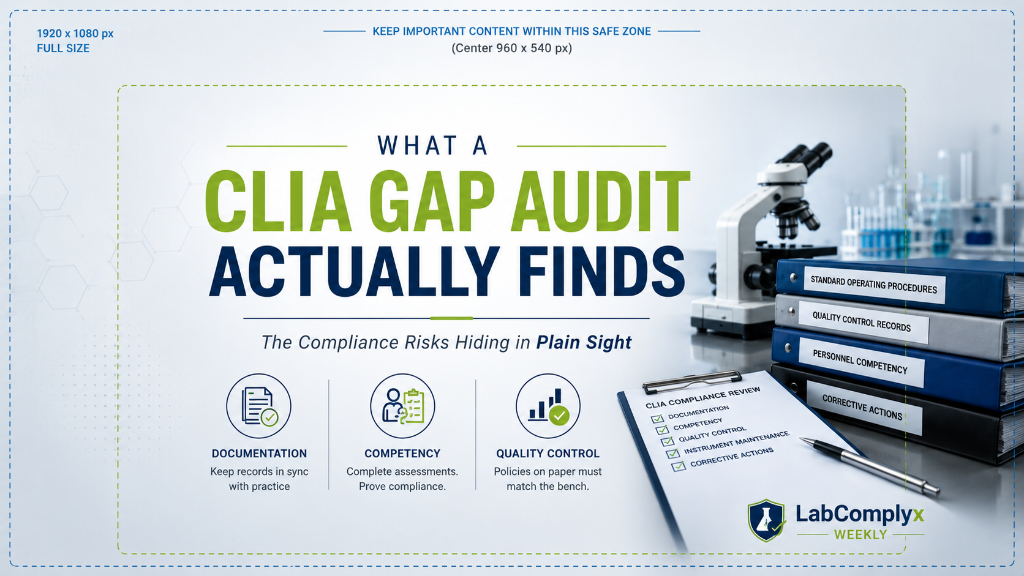
The Compliance Risks That Rarely Make Headlines—But Frequently Trigger Citations
The most expensive compliance failures rarely begin with a catastrophic event. They begin with small inconsistencies that quietly become your laboratory's normal. A well-executed CLIA gap audit exists to uncover those discrepancies before an inspector does.
42 CFR §493.1251, 42 CFR §493.1236, 42 CFR §493.1451–493.1457
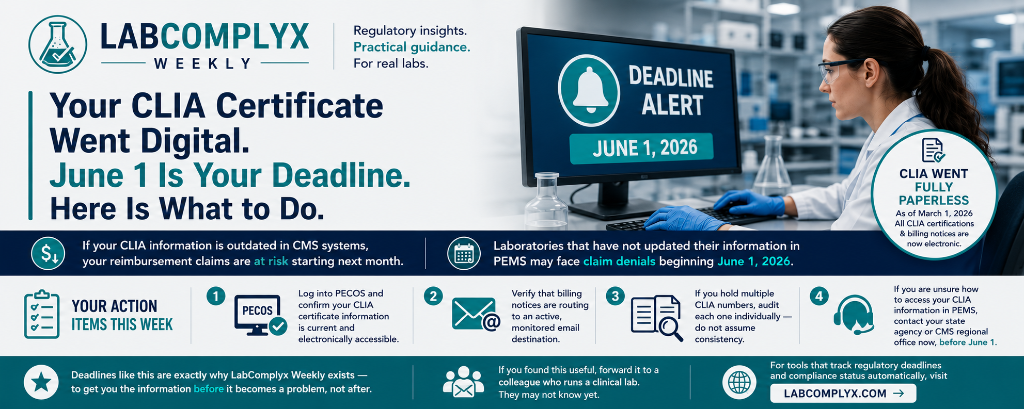
Your CLIA Certificate Went Digital. June 1 Is the Deadline Most Labs Still Haven't Fully Processed.
As of March 1, 2026, CMS completed its transition to paperless CLIA operations. Starting June 1, labs with outdated information in CMS systems may face reimbursement disruptions. Here is what your lab needs to do this week.
CLIA · CMS · PECOS · PEMS
Cannabis and Hemp Labs: Defensibility Is the Product You Are Actually Selling
In 2026, the scrutiny on cannabis and hemp testing has never been higher — and the standards have never been more consequential. Here is what it takes to build quality that holds up when someone looks hard.
21 CFR Part 1301 (DEA Registration); ISO/IEC 17025; USDA Hemp Program
Environmental Regulation Is Always a Laboratory Issue First
When EPA finalizes a new rule or revises a contaminant standard, the first place the impact appears is in a testing laboratory. Here is what April 2026 regulatory activity means for labs across multiple sectors — and why early awareness is a competitive advantage.
40 CFR Part 141; TSCA Section 8(a)(7); EPA Method 1633A

CLIA, FDA, and Your Quality System: They Are Not Three Separate Programs
Clinical laboratories in 2026 operate inside overlapping regulatory frameworks that most quality systems treat as disconnected silos. Here is how to align them into one architecture that actually protects your work.
42 CFR Part 493 (CLIA); 21 CFR Part 11; CAP 2026 Checklists

"Laboratory Error" Is Not a Root Cause
When results fail, the investigation you conduct is the most scientifically important work your laboratory will do. Here is what 2026 enforcement tells us about what rigorous looks like — and what it definitely does not.
21 CFR Part 211.192; FDA OOS Guidance 2006
The Warning Letters Are Telling You Something Important
FDA's 2026 enforcement surge is not about dramatic misconduct. It is about ordinary systems that quietly stopped working — and the laboratory leaders who can still course-correct before an inspector arrives.
21 CFR CGMP; CLIA 42 CFR 493; FSMA

Clinical Trial Transparency Is a Laboratory Responsibility, Too
In April 2026, FDA reminded more than 2,200 companies that results must be disclosed. Central and specialty laboratories hold a critical piece of that evidence chain — and it starts with how you manage data today.
21 CFR Part 11; GCP; ClinicalTrials.gov Requirements

A Quality Agreement Is Not a Shield
FDA's April 2026 warning letter to Medical Products Laboratories, Inc. makes one thing undeniable: contract status does not reduce your regulatory accountability. Here's what every outsourced testing lab must understand.
21 CFR Part 211; CGMP Contract Lab Requirements

Your 483 Response Is Part of Your Quality System
In March 2026, FDA released draft guidance that changed the way every regulated laboratory should think about inspection responses — not as paperwork, but as proof of who you really are.
21 CFR CGMP; FDA 2026 Draft Guidance on 483 Responses
Inspection Ready: How Small Labs Survive FDA Scrutiny
FDA's 2025 inspection pace is back at pre-pandemic levels — and unannounced inspections are expanding. Here's how small labs stay inspection-ready without a dedicated compliance staff.
21 CFR 211; 42 CFR 493

Out-of-Specification Results: The Correct Investigation Protocol
An OOS result is not a problem — an improperly investigated OOS result is. FDA's two-phase OOS investigation framework is mandatory for regulated labs. Here's how to do it right.
21 CFR 211.192; 21 CFR 211.194

Environmental Labs and PFAS: Method Selection & the Shifting Floor
EPA's new PFAS drinking water Maximum Contaminant Levels are finalized. Environmental labs must now navigate method selection, detection limits, and QC requirements for a chemically diverse contaminant class.
40 CFR Part 141; EPA Method 533; EPA Method 537.1

Hemp Testing Labs: The November 2026 Regulatory Cliff
The hemp testing industry faces a hard deadline in November 2026: DEA's interim final rule on hemp processing expires, and federal hemp testing requirements will shift significantly.
7 CFR Part 990; DEA Interim Final Rule 2021
Anatomy of an FDA Warning Letter: What to Do in 15 Days
Receiving an FDA Warning Letter is not the end — but your 15-business-day response window starts immediately. Here's the correct protocol, from triage to response.
21 CFR 211; 21 CFR 117; 42 CFR 493

Food Testing Labs & FSMA: What the LAAF Rule Means for You
FDA's Laboratory Accreditation for Analyses of Foods (LAAF) program is now operational. If your lab tests food for FDA-regulated purposes, accreditation is no longer optional.
21 CFR Part 1 Subpart M; FSMA LAAF Rule
CLIA 2025: The Biggest Updates in Decades Are Now Enforced
CMS rolled out major CLIA changes effective January 2025. If you haven't updated your PT enrollment, personnel records, and email address on file with CMS, you may already be out of compliance.
42 CFR Part 493
Your Audit Trail Is Your First Line of Defense
FDA issued 470+ warning letters in 2025. Data integrity failures were the thread running through nearly every one. Here's what that means for your lab.
21 CFR Part 11
Stay Compliant
Never Miss a Critical
Compliance Update Again
Get weekly compliance guidance delivered straight to your inbox — written specifically for small and independent lab operators.
No credit card required · Unsubscribe anytime